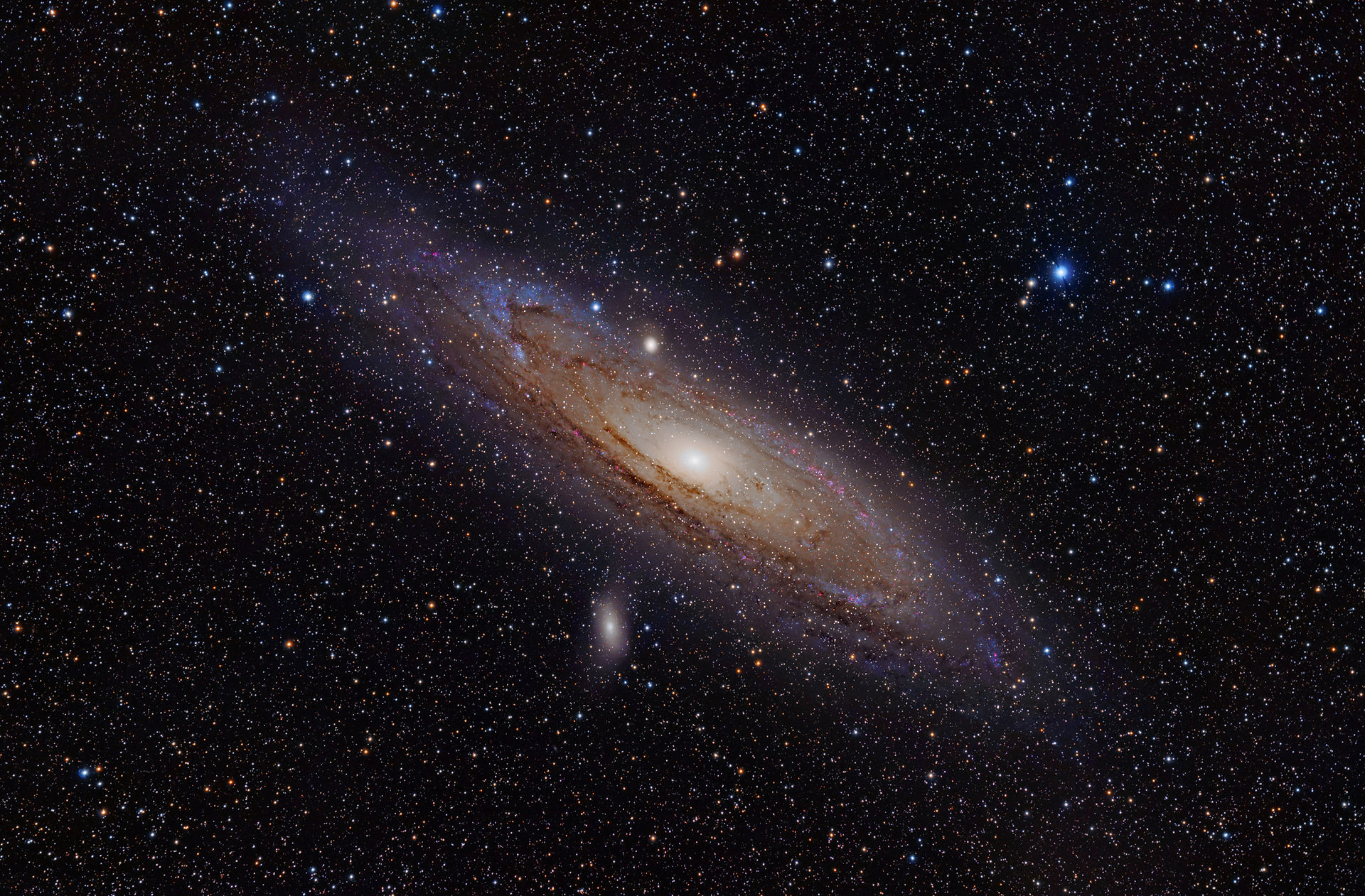

The Andromeda galaxy: a guide to observation and curiosities
- spacecrewemail
- Mar 30, 2021
- 2 min read
Today the SpaceCrew after a satisfying evening of observation in search of the wonders of the deep sky will take you to discover the queen of the deep sky par excellence: the Andromeda galaxy.
This galaxy, also known as M31 according to the famous Massier catalogue, is located at a distance of about 2.538 million light years from our small planet and with its billion stars (approximate number) is one of the brightest deep sky objects observable in our skies.
Its size is larger than our galaxy both in terms of mass, which is 20% larger than the Milky Way, and in terms of the number of stars.

However, the Andromeda galaxy M31 remains the closest galaxy to ours. Every day it gets closer and closer to us with an estimated speed of 400,000 km/h making its movement tend towards blue.
One curiosity, however, could be its peculiar shape... From the photos, kindly provided by the most powerful telescopes, you can see its spiral shape. But the reality is quite different! Its shape is actually like that our galaxy's shape: a barred spiral. Yet the axis of the bar is almost exactly on our line of sight making its structure very confusable with the more typical extended spiral.
Having said these brief words of introduction let us now move on to how to locate and observe this splendid deep sky object.
Locating
In order to find M31 in your sky you will have to observe near the Andromeda constellation of the same name recognisable below Cassiopeia and exactly next to Pegasus.

Once you have found the constellation you will have to jump between its stars intersecting each other until you find the galaxy you are looking for... Go in the direction of Mirach -the central star of the constellation- and then follow it by drawing an imaginary line that connects the star with the other 2 visible above it (μ Andromedae and ν Andromedae)... Extend the line and exactly above the second star you will find the galaxy.
Observation
To observe the galaxy it is necessary to have a sky free of light pollution. It is so bright that the naked eye can admire it. In fact, even simple binoculars are sufficient to recognise its typical elongated shape and telescopes from 114 mm upwards to distinguish its details. The larger the mirror, the more you will be able to admire it.
As we are not experts in this type of astrophotography, we can only report what we know. In fact, simple cameras or even mobile phones (in some cases) are sufficient to immortalise it.
Page instagram ➡️➡️➡️➡️➡️ @_spacecrew
Telegram ➡️➡️➡️➡️➡️ @spacecrewgroup
If you want to find out more interesting facts, here is another post you might like:
We apologise for possible typing errors within the post, if there are any please contact us.


Comments